
Briefs by Display Setting
A display reference becomes useful when a retail team can review it from the shopper’s approach and translate it into production questions. A polished image cannot show whether the focal point remains visible, whether product hierarchy survives the available depth, or whether staff can replenish the setting without disturbing it.
The strongest retail display brief examples compare conditions rather than styles. They record what the shopper sees first, which product or message anchors the composition, what competes with it, and which assumptions remain unconfirmed before fabrication or installation.

More specific pages
These pages continue the topic in smaller, more specific directions.
What Changes Between Retail Display Settings?
A storefront window, entrance display, product-focus display, seasonal campaign, and pop-up may use similar props, graphics, fixtures, and product groups. Their review conditions differ.
| Setting | Primary review question | Dependency to record |
|---|---|---|
| Storefront window | What survives from the outside approach angle? | Viewing direction, window geometry, and outside-facing message |
| Entrance display | How does the display relate to movement through the threshold? | Circulation, door movement, sightlines, and staff access |
| Product-focus display | Does the featured item hold its place in the product hierarchy? | Supporting stock, display depth, attachments, and replenishment |
| Seasonal campaign | Does the theme support the merchandise and campaign message? | Timing, stock changes, graphics, prop storage, and removal |
| Pop-up | Can the concept retain its hierarchy in a temporary setting? | Transport, assembly, pack-down, footprint, and venue conditions |
A window is often judged while the shopper is moving past it. An entrance display is encountered during a transition, where approach direction and circulation affect the first readable element. A product-focus display depends more directly on the relationship between the featured item, supporting stock, and the next point of attention.
Seasonal campaigns may give more weight to a time-sensitive theme. Pop-ups may depend on compact modules, portable graphics, and stock stored outside the primary display zone. These conditions belong in the brief rather than remaining hidden inside the reference image.
Use the Same Comparison Set
- What is the primary and secondary shopper approach angle?
- Is the display viewed while moving, pausing, entering, or browsing?
- Which item, collection, or message is the focal point?
- How many product groups can be understood at a glance?
- What display depth is available?
- How will stock, props, or graphics be replenished or replaced?
- Which lighting conditions are visible, assumed, or unmeasured?
- Which dimensions, attachments, loads, electrical elements, circulation conditions, or rights require confirmation?
Research on storefront displays distinguishes merchandise-focused arrangements from more artistic approaches that rely on interpretation. That distinction can help a team compare references, but it does not create a universal ranking. The useful decision is which approach fits the documented shopper, product, campaign, and site conditions.
Retail Window Display Brief Examples
A retail window display brief should begin with the pedestrian viewpoint. The image may show a balanced composition, but the brief needs to describe what remains legible from the likely approach angle and from less direct views.
Seasonal Window Display Brief Example
A seasonal window concept may use a recognizable theme, repeated props, a limited color scheme, and a small number of featured products. The theme can organize the reference, but it should not displace the merchandise unless that is an intentional choice.
- Campaign theme and operating time frame
- Primary product family or collection
- Intended focal point and supporting elements
- Dominant viewing direction and alternate sightlines
- Product-to-prop relationship
- Visual weight across upper, middle, and lower zones
- Required graphic or promotional message
- Expected stock changes during the campaign
- Lighting assumptions requiring review
- Installation, removal, and storage dependencies
Comparative material on window dressing uses focal points, color, product quantity, props, visual weight, and thematic treatment as review criteria. Use those terms to structure the comparison, while keeping the evidence status visible.
A seasonal concept becomes fragile when large props attract attention but the product is still expected to anchor the window. It also becomes difficult to maintain when repeated changes have no documented replenishment, replacement, or storage route.
Storefront Display Brief Example
A storefront display brief should separate the outside-facing message from the interior merchandising system. A window may communicate store identity, product category, or a collection, while the reference leaves the entrance relationship and interior fixture unresolved.
- Can the product category be identified before the shopper reads the copy?
- Does the focal point remain visible from a side approach?
- Does the entrance frame or interrupt the composition?
- Are mannequins, props, graphics, or product stacks competing for attention?
- Is the reference based on a measured site or an illustrative image?
- Does the window condition change the viewing relationship?
Flat, arcade, and corner windows create different viewing conditions. The brief should record the relevant geometry and approach angles without inferring exact dimensions from a photograph or perspective drawing.
Entrance Display Brief Example
An entrance display is seen during movement through a threshold. The shopper may approach directly, pass on one side, or encounter the display while orienting themselves inside the store.
The brief needs a clear relationship between attention and circulation:
- What is visible before the shopper reaches the entrance?
- What becomes visible after crossing the threshold?
- Does the display frame the entry or narrow the apparent route?
- Which products are intended to be noticed first?
- Is the display double-sided or oriented toward one primary direction?
- Can staff replenish it without interrupting the route?
- Which reach, obstruction, or circulation questions require current local guidance and qualified review?
Government accessibility guidance can frame questions about circulation, reach, and potential obstructions. It cannot establish that a particular display meets the requirements for a specific site. Dimensions, local conditions, installation details, and responsible-party checks remain open until documented.
An entrance reference may look effective because it occupies a strong visual position. That position can also create dependencies around door movement, queueing, visibility, staff access, and replacement work. Record those dependencies before treating the image as a fabrication direction.
Product-Focus Display Brief
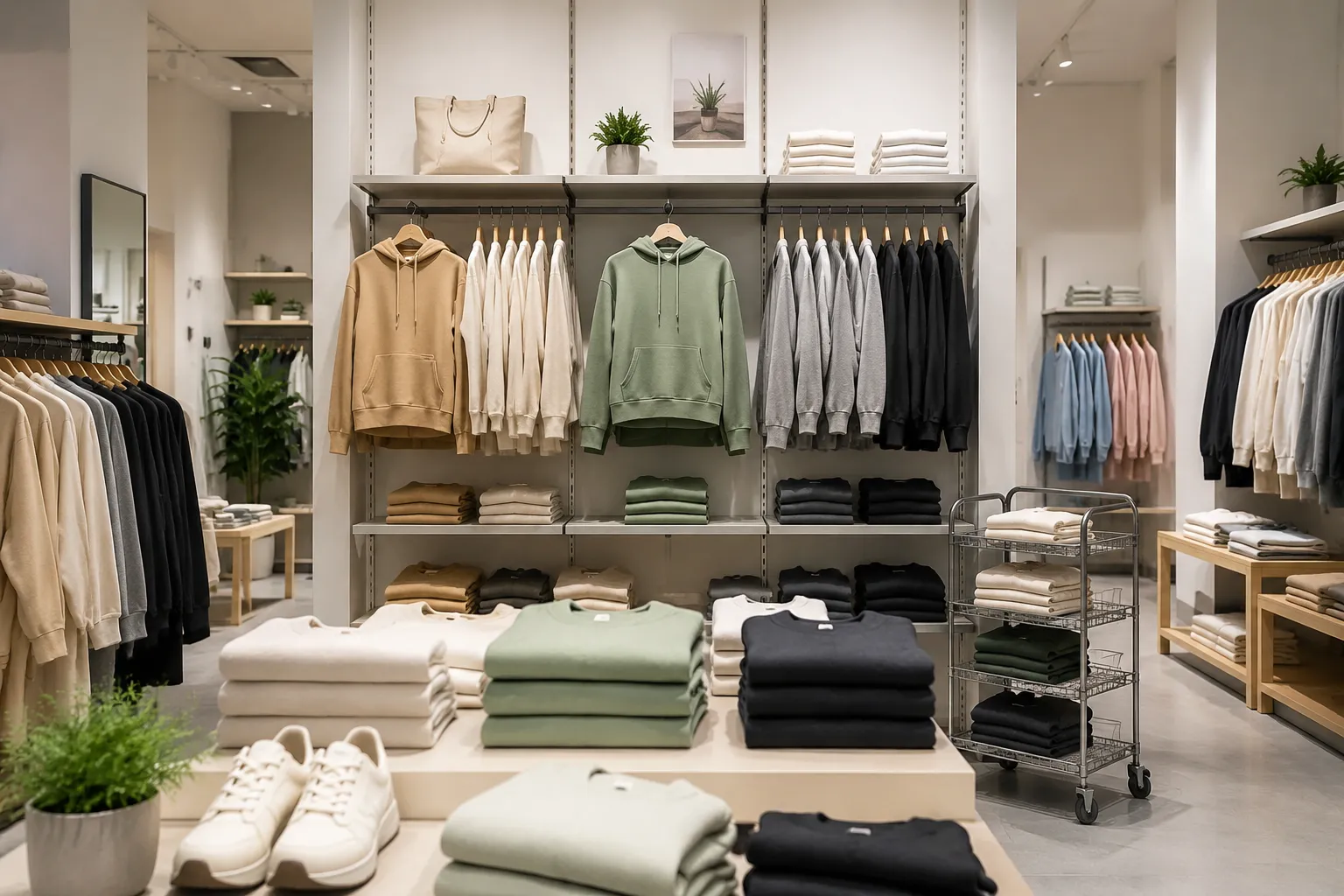
A product-focus display gives one product, collection, or product family a defined visual role. Supporting items should clarify the hierarchy rather than compete with the anchor.
- Featured product or product family
- Supporting products and their relationship to the anchor
- Intended order of visual attention
- Grouping logic and display direction
- Display depth and rear-stock assumptions
- Fixture and attachment information
- Replenishment frequency and access route
- Lighting position and visibility assumptions
- Product, brand, and image-rights confirmations
Research on shelf-space planning treats products as members of families that may be arranged through hierarchical merchandising rules. It also connects facings, display orientation, stock quantity, shelf position, and backroom capacity. For a brief, these are dependencies to document, not a universal arrangement prescription.
Replace descriptions such as “clean” or “balanced” with observable decisions. State what belongs together, what separates categories, and which group must remain legible from the first sightline.
More products do not automatically create a stronger display. Increasing quantity may communicate choice, while excessive quantity can weaken the intended hierarchy. Use the reference to identify the intended assortment level, then compare it with actual inventory and replacement conditions.
Pop-Up Display Brief Example
A pop-up has a temporary setting, but temporary does not mean simple. The reference may depend on a compact footprint, repeatable modules, portable graphics, or stock stored outside the primary display zone.
- Venue and viewing directions
- Footprint and display depth
- Product quantity available on site
- Transport and storage assumptions
- Assembly and pack-down sequence
- Fixture connections and attachments
- Graphic replacement or campaign changes
- Staff replenishment route
- Lighting availability and unmeasured assumptions
- Electrical, load, circulation, and installation questions for responsible review
- Asset provenance and documented usage status
A pop-up concept can favor modular grouping when the venue or footprint may change. It can also lose hierarchy when every module receives equal emphasis. Identify the anchor module and state what happens when the available product range is smaller than the reference suggests.
An illustrative walkthrough should be labeled concept-stage, non-final, and unmeasured unless supplied documentation states otherwise. A render can show intended composition; it cannot confirm fit, support conditions, installation method, or site performance.

Compare Sightline, Hierarchy, and Depth Together
These variables are often reviewed separately even though each changes the others. Read the reference from the shopper approach, then test the composition in its operating state.
Sightline
Sightline describes what is visible from a relevant shopper position. Mark the primary approach, secondary approach, and any point where the display is likely to be viewed obliquely.
A reference that works from one angle may obscure the featured product from another. Record the visible evidence separately from the assumption about what the shopper will notice.
Focal Point
A focal point is the element the composition asks the shopper to notice first. It may be a product, mannequin, graphic, color block, prop, or spatial opening.
Connect the focal point to the brief objective. If the product is the anchor, props should support its scale and context. If the campaign message leads, product placement should not make the message difficult to read.
Product Hierarchy
Product hierarchy records the order in which product groups are expected to be understood. Use concrete labels such as hero product, supporting collection, accessory group, and background stock where those distinctions fit the assortment.
Grouping and direction can be deliberate merchandising decisions, but research does not determine the correct arrangement for every category or store. Record the intended order and the evidence behind it.
Display Depth
Depth affects visibility, access, layering, and replenishment. A deep composition may create a stronger foreground-to-background relationship, while the rear product or graphic may disappear from common approach angles.
- Front, middle, and rear display zones
- Product visibility in each zone
- Prop interference
- Staff access and replacement route
- Rear-stock assumptions
- Cleaning and maintenance access
- Attachment or load information still required
Do not infer measurements from perspective drawings. Mark each unmeasured dimension for confirmation.
Retail Product Grouping and Replenishment Planning
A display brief should describe how the composition behaves after products are removed. This matters for product-focus displays, promotional fixtures, and seasonal arrangements.
Shelf-space research distinguishes visible facings from the quantity stored behind each facing. It also connects showroom space, backroom capacity, display orientation, stock quantity, and order frequency. These models expose dependencies; they do not prescribe a labor plan or inventory level for a particular retailer.
- Which products must remain visible after partial depletion?
- Is the display intended to hold reserve stock or only a sample?
- Where is replacement inventory stored?
- How often will staff replenish it?
- Does replenishment require moving props or fixtures?
- Does the hierarchy change when one product family runs low?
- Are substitute products documented?
- Will stock quantities change during the campaign?
Include a fallback state in the retail product grouping brief. The display needs a documented response when the preferred product, size, color, or pack quantity is unavailable.
This does not require predicting demand. It requires acknowledging that the reference may show a fully populated display while the operating display changes throughout the campaign.
Lighting as a Display Brief Variable
Lighting belongs in the brief because it affects what is revealed, obscured, emphasized, or reflected. The available material does not provide measured lighting results or a technical prescription.
- The concept appears to assume even illumination across the product group.
- The image shows a brighter focal zone, but the lighting method is unconfirmed.
- Reflections, glare, shadow, or color shifts may alter product visibility on site.
- Fixture position, control assumptions, and electrical dependencies require responsible review.
Keep lighting connected to the shopper-view decision. A short dependency note is enough when the main question concerns display setting, focal order, and product visibility.
Installation Dependencies and Review Boundaries
A reference image can suggest materials, fixtures, props, mounts, graphics, and electrical elements. It cannot establish whether those elements suit a particular site.
Assign confirmation for:
- Site dimensions and clearances
- Fixture connections and attachment methods
- Shelf or product loads
- Stability and support conditions
- Electrical supply and installation
- Fire and local site requirements
- Circulation and reach conditions
- Cleaning, maintenance, and replacement access
- Brand permissions and image or asset usage rights
- Transport, storage, assembly, and removal
These are decision prompts, not approval statements. Current project documentation and the responsible qualified parties must determine the applicable requirements.
A concept-stage brief is easier to review when each unresolved assumption has an owner and a status such as measured, source-listed, unconfirmed, or awaiting site review. Record the assumption before the build.
A Review Route for Comparing Concepts
When several display references compete, review them against the same shopper, product, material, and operational criteria.
- Set the shopper viewpoint. Record the approach angle, expected viewing distance, movement direction, and alternate sightlines.
- Name the anchor. Identify the product, collection, message, or visual element that should receive primary attention.
- Map the hierarchy. Group supporting products and props according to the intended order of understanding.
- Check depth. Mark what is visible in front, middle, and rear zones. Note any product or message hidden by layering.
- Test the operating state. Describe what happens after products are removed, replaced, or replenished.
- Record lighting assumptions. Separate visible brightness or contrast from unmeasured fixture, glare, shadow, and electrical conditions.
- Assign site questions. Send dimensions, circulation, reach, loads, installation, fire requirements, rights, and local conditions to the responsible review process.
- Choose the reference for a reason. State which concept best fits the documented conditions. Do not describe it as universally superior.
This route keeps concept appeal separate from measured feasibility. It also gives designers, producers, installers, and rights-holders a shared list of decisions and open questions.
Common Mix-Ups in Display Briefs
Artistic and Merchandise-Focused Displays
An artistic display may communicate a theme or store image through implicit cues. A merchandise-focused display makes the product offer more direct. The choice depends on shopper context, campaign purpose, and the intended level of interpretation.
A visually complex reference does not automatically communicate more effectively.
Focal Point and Product Quantity
A display can contain many products while retaining a focal point, but additional items may compete with the anchor. Record the hierarchy instead of using product count as a proxy for strength.
Display Depth and Inventory Capacity
A deep composition may require more stock, access, or staff time than the image reveals. Treat the rear layer as an operating dependency rather than only a styling layer.
Lighting Appearance and Lighting Evidence
A bright-looking render is not a measurement. A photograph may also hide glare, shadow, color shift, or changing ambient conditions. Keep visual observation and technical assumption separate.
Visual Reference and Production Confirmation
A reference can establish a direction for grouping, color, prop use, and focal-point placement. It cannot confirm site fit, loads, attachments, rights, or installation conditions.
FAQ
What should a retail display brief include?
Include the setting, shopper viewpoint, approach angle, focal point, product hierarchy, grouping logic, display depth, props, graphics, inventory assumptions, replenishment route, lighting assumptions, installation dependencies, and unresolved review questions.
How do I write a retail window display brief?
Start with what the shopper sees from outside. Describe the primary product or message, viewing direction, supporting elements, and features that may obscure or compete with it. Add campaign timing, stock changes, and site questions.
What is the difference between a storefront and entrance display brief?
A storefront brief focuses on the outside-facing view and the message understood before entry. An entrance brief also addresses movement through the threshold, approach from more than one direction, circulation, and staff access for replenishment.
How should product hierarchy appear in a brief?
Name the anchor product or family, then identify supporting groups and their intended order of attention. Include display direction, facings where relevant, and what should remain visible when stock changes.
Should lighting have its own section?
It can remain a short dependency section when the main decision concerns display setting. Record what the reference appears to assume and which visibility, glare, shadow, color, fixture, or electrical conditions require confirmation.
Can a mockup confirm that a display will fit?
No. A mockup can communicate an illustrative composition. Measured dimensions, site conditions, attachments, loads, circulation, installation, and other production questions require separate confirmation.
The Completion Point
A useful brief does not end with a preferred image. It ends with a reviewable decision.
The team should be able to state which display setting is being considered, what the shopper sees first, which product hierarchy the concept supports, how depth affects visibility and replenishment, which lighting assumptions remain open, and who must confirm site or production dependencies.
That record turns a reference into a working concept boundary. It preserves the visual idea while making its assumptions visible before they become fabrication, installation, inventory, or rights questions.
Sources
- How do storefront window displays influence entering decisions of clothing stores?
- Store-window creativity's impact on shopper behavior
- Effect of replenishment and backroom on retail shelf-space planning
- Allocating products on shelves under merchandising rules: Multi-level product families with display directions
- Visual Merchandising Approaches: A Comparative Study of High-End and Fast-Fashion Window Dressing Design
- U.S. Access Board: ADA Accessibility Guidelines