
Brand Marks and Artwork Status
A display may place a logo above the focal product, campaign artwork across the backdrop, and branded graphics on several props. From the shopper approach, those elements can look resolved while their brand asset rights remain uncertain.
Review the visible use first: what appears, where it sits, and how strongly it competes for attention. Then examine the documentation supporting that exact use. A Brand Mark and Artwork Status Record connects those views without deciding ownership, permission scope, or other legal questions.

More specific pages
These pages continue the topic in smaller, more specific directions.
Start With the Visible Display
A small mark on a product plinth creates a different review condition from artwork covering a full window. Inventory each element as part of the shopper-facing composition before opening asset folders or approval records.
For every visible mark or artwork element, record:
- The logo, photograph, illustration, pattern, character, type treatment, or campaign graphic shown.
- Its placement on the window, entrance, fixture, prop, sign, screen, or product display.
- The main approach angle, sightline, focal role, and relationship to product hierarchy.
- The proposed output, such as printed vinyl, rigid graphics, fabric, packaging, screen content, or a dimensional application.
- Whether the visual is a concept render, mockup, prior campaign reference, supplied file, or placeholder.
This pass establishes scope. It prevents a dominant background image from receiving less scrutiny than a small logo simply because the logo is easier to identify.
Repeated artwork also needs attention. A single image may appear on the backdrop, fixture panels, entrance sign, and digital screen. Record each materially different use rather than assuming one review covers every placement.
Separate the Six Status Questions
A useful brand asset rights record does not compress every issue into one yes-or-no field. Provenance, proposed use, available evidence, restrictions, approval responsibility, and unresolved questions describe different conditions.
Rights metadata research supports this separation. Recorded information can help a reviewer understand what is known and what still requires investigation, but the record does not determine whether a particular use is permitted.
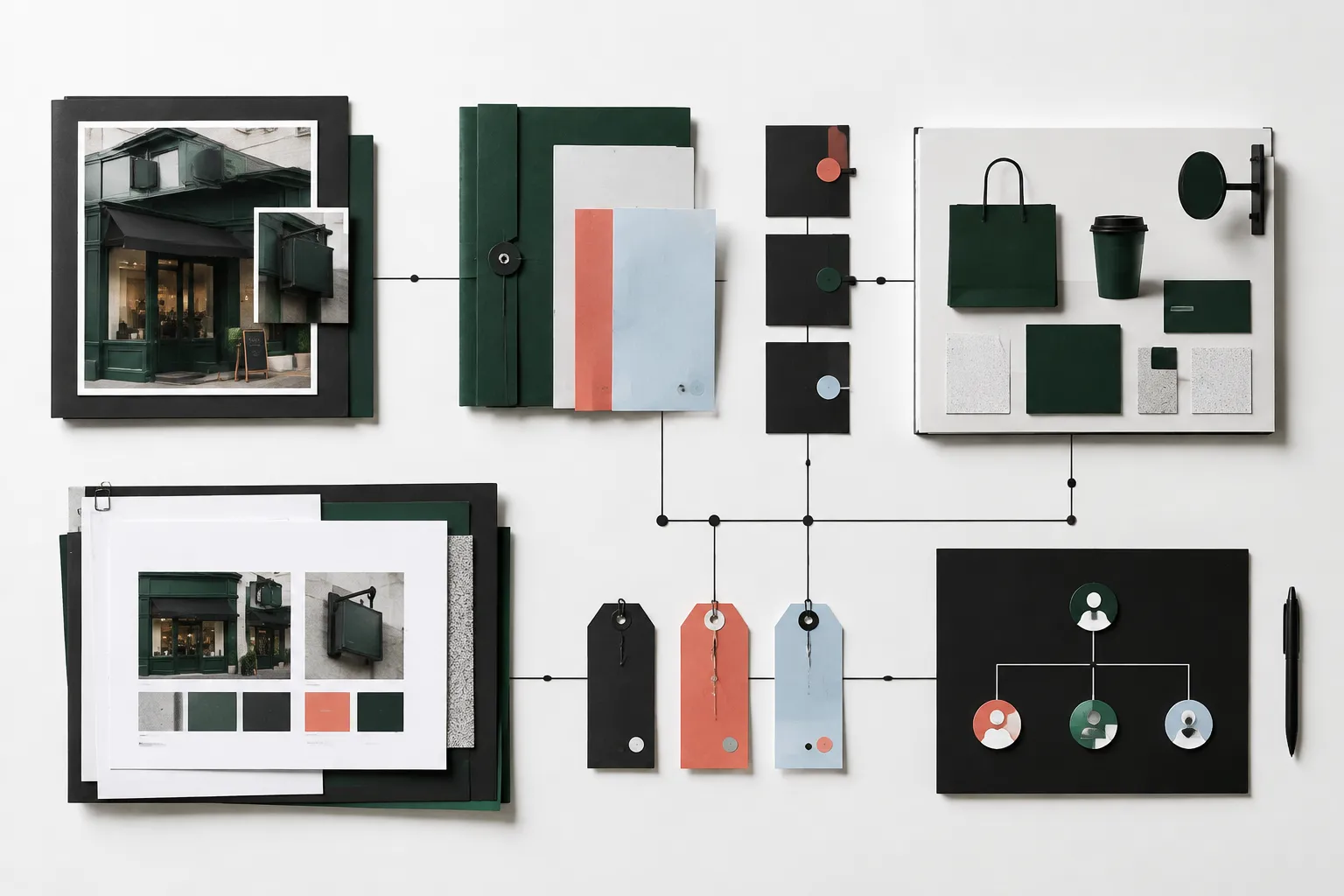
1. Visible Asset Description
Describe what the concept includes in plain retail language. “Brand logo” is too broad. “White horizontal wordmark above the central footwear plinth” is easier to match with the mockup, artwork file, and production specification.
Identify whether the element is a primary mark, campaign lockup, product photograph, supplied illustration, repeated pattern, partner mark, artwork-based typography, adapted graphic, or placeholder. Note visible cropping, recoloring, compositing, redrawing, or other changes.
Keep observation separate from interpretation. The image shows a mark in a particular position. It does not show who controls it or which uses the available records address.
2. Brand Asset Provenance
Brand asset provenance records where the reviewed file came from and how it reached the concept. It is a chain-of-record question, not a conclusion about ownership.
Useful entries include the asset identifier, source repository or supplier package, file name, format, documented creator, version, revision date, provider, retrieval date, and location of supporting records. Record any relationship to earlier versions or campaign files.
Provenance research emphasizes the context surrounding a digital record. In a retail workflow, that context may include campaign history, modifications, supplier handoffs, and the team maintaining the file. If the route cannot be reconstructed, label the source unresolved instead of filling the gap with an assumption.
3. Proposed Brand Asset Use
Permission evidence cannot be assessed in the abstract. The record must describe what the concept proposes to do with the asset.
- Name the campaign, display area, physical or digital medium, and intended visual prominence.
- Record dimensions when measured or specified, along with crop, color, animation, compositing, or other treatment.
- Identify repetition across surfaces, stores, venues, markets, or channels.
- State the intended display period and the suppliers expected to receive the file.
- Note whether the asset may be stored, adapted, or reused after the campaign.
Concept renders and mockups should remain labeled as concept-stage and unmeasured unless project records establish otherwise. A rendered logo spanning a window can show focal role and illustrative scale. It cannot establish measured fit, installation conditions, permitted alteration, or rights scope.
4. Available Permission Evidence
The evidence field should point to material available for review. The existence of a document does not establish that it covers every proposed output.
Possible entries include a rights-holder record, usage agreement, current brand standards, campaign-specific decision record, written asset instructions, commission terms, supplier handoff note, prior campaign correspondence, or no evidence currently located.
Record the document title, location, date, version, parties, and stated scope when available. Retain the underlying exchange rather than replacing it with a vague entry such as “approved by email.”
Machine-actionable rights research commonly separates permissions, prohibitions, and obligations. A retail record can use that practical distinction in plain language: which use is described, which treatment is restricted, and which conditions are stated. When the documents do not answer the current question, use permission status unconfirmed.
5. Source-Listed Asset Restrictions
Record restrictions as they appear in the available source material. Do not extend them by analogy, memory, or assumptions based on prior campaigns.
- Permitted media, outputs, campaign dates, markets, venues, or participating retailers.
- Conditions affecting crop, color, proportions, orientation, animation, or compositing.
- Clear space, placement, attribution, credit, or notice requirements.
- Limits on supplier access, file sharing, storage, adaptation, or reuse.
- Required master files, artwork versions, proof stages, or review routes.
A source-listed restriction is not a complete assessment of the proposal. The record may be partial, dated, or connected to another medium or campaign. Note those limits beside the restriction.
6. Approval Ownership and Open Questions
Every unresolved item needs a named confirmation route. “Team to check” is too vague for a production handoff.
Record the responsible person, role, department, rights holder, retailer, agency, producer, or other reviewer. Pair that owner with a specific question, the evidence package required, a decision point, and any dependency on measurements, artwork revisions, supplier selection, or campaign scope.
Responsibility may be divided. One party may review brand presentation, another may hold the relevant records, and another may control supplier release. The status record should reveal that division rather than hiding it behind one label.
Brand Mark and Artwork Status Record
The following fields create a reviewable working record. They are an editorial framework for organizing the handoff, not a universal set of legal requirements.
| Field | What to record | Review purpose |
|---|---|---|
| Asset ID | Unique working identifier | Connects the concept, file, evidence, and production package |
| Visible element | Mark or artwork as shown | Defines the item under review |
| Placement and focal role | Surface, sightline, approach angle, and hierarchy | Connects the record with the shopper-facing concept |
| Source and version | Repository, file name, provider, date, and revision | Reduces source and version ambiguity |
| Proposed use | Medium, placement, treatment, campaign, duration, and recipients | Defines the use requiring confirmation |
| Permission evidence | Available document and its location | Shows what the responsible reviewer can inspect |
| Source-listed restrictions | Recorded limitations and obligations | Identifies conditions affecting design or handoff |
| Status label | Documented, concept-stage, pending confirmation, or unresolved | Supports scanning without replacing the full record |
| Approval owner | Named responsible party or role | Assigns the next decision |
| Open questions | Specific missing facts or decisions | Prevents uncertainty from disappearing during handoff |
| Next checkpoint | Required action and timing | Connects review with production sequencing |
A concise label should always point to the fuller evidence record. It is a navigation aid, not the decision itself.
Compare Assets by Use, Not Just by File
Teams often review an asset once and carry that result across every occurrence. That approach becomes fragile when the proposed outputs differ.

| Proposed appearance | What changes in the review |
|---|---|
| Small mark on a product plinth | Placement, finish, attachment method, and supplied mark version |
| Full-window graphic | Scale, crop, visibility, medium, campaign dates, and site-specific output |
| Repeated motif across props | Repetition, adaptation, supplier distribution, and produced-piece inventory |
| Animated screen sequence | Motion treatment, duration, compositing, file format, and screen context |
The source file may be identical, but the proposed use is not. Create separate records or connected sub-records for materially different outputs.
The same rule applies to variants. A landscape image, a tightly cropped portrait version, and a composite containing product cutouts should not share one status solely because they originated from the same master.
Common Status Misreads
File Availability Is Not Permission Evidence
A file in a shared folder establishes availability. It does not explain whether the records cover the exact campaign, placement, adaptation, duration, or supplier handoff.
Track file condition and permission evidence separately. A file may be available while its version is uncertain, or technically usable while the supporting documentation remains partial or unresolved.
Portal Access Does Not Define the Proposed Use
A portal download may provide provenance, version information, presentation standards, or usage notes. Compare those records with the actual retail proposal rather than treating access as the final status.
Check whether the available material addresses the selected version, environment, medium, alteration, campaign dates, supplier distribution, and any review required after adaptation.
Prior Use Does Not Set the Current Scope
An earlier campaign file can support version history and help locate an agency, supplier, or decision trail. The current record still needs the new placement, output, dates, participating parties, and modifications.
Historical use is provenance evidence. It does not replace current confirmation.
Metadata May Be Only Part of the Record
Embedded metadata can identify a creator, file date, description, or other context. Institutional digital asset management research also shows that relevant information may be distributed across different repositories and teams.
A Metropolitan Museum of Art case described image, object, photographer, and rights information being maintained in separate systems. The example comes from museum practice, not retail production, but the review lesson transfers: the file and the records needed to interpret it may not live together.
Document where each part resides. Empty metadata does not establish an absence of restrictions, while populated metadata may not contain the complete permission record.
Brand Presentation and Rights Status Are Different Reviews
Brand standards may guide proportions, clear space, color, or placement. Permission evidence addresses a different question.
A mockup might follow presentation guidance while campaign scope or supplier access remains unresolved. Another concept may have supporting permission records but use an outdated or altered mark. Keep the two reviews connected and distinct.
A Practical Review Route
- Inventory the visible assets. Mark every logo, lockup, image, illustration, pattern, partner mark, placeholder, and artwork treatment on the latest shopper-view mockup.
- Match each element to a source file. Check for similar file names, outdated lockups, preview files standing in for master artwork, supplier-redrawn marks, unidentified crops, and composites with unlisted components.
- Define the proposed output. Record the medium, location, treatment, dates, intended recipients, and measured dimensions when available. Keep site, installation, accessibility, electrical, and other physical checks in their appropriate review routes.
- Locate and summarize the evidence. Point to the available records and state only what they document. Mark gaps instead of inferring scope from filenames, prior use, or informal notes.
- Record restrictions and dependencies. Surface conditions affecting crop, color, display period, supplier access, final artwork review, retailer lists, venues, or production methods.
- Assign confirmation ownership. Give each open question to a named party and connect its due point to artwork release, supplier quotation, preflight, proof review, or installation scheduling.
A polished preview can obscure source gaps. Record the assumption before the build.
Worked Concept-Stage Scenario
An illustrative storefront concept shows a seasonal illustration behind three product plinths. A brand wordmark sits above the central product, while a partner mark appears near the entrance message.
From the approach angle, the illustration controls the focal field. The wordmark anchors brand recognition, and the partner mark remains secondary but visible. The mockup is concept-stage and unmeasured.

Seasonal Illustration
- Source: Campaign presentation export.
- Proposed use: Full-window printed backdrop with a wide crop.
- Available evidence: No permission record located in the concept package.
- Status: Restrictions and permission scope unresolved.
- Confirmation route: Campaign asset owner and responsible brand reviewer.
- Open questions: Master file, creator record, crop documentation, display dates, supplier release, and adapted-proof review.
Primary Wordmark
- Source: Documented brand asset repository.
- Proposed use: White mark applied above the central plinth.
- Available evidence: Current presentation guidance located; campaign-specific scope remains unconfirmed.
- Restrictions: Source-listed spacing and version requirements recorded.
- Confirmation route: Responsible brand reviewer.
- Open questions: Measured size, production file version, finish, and proof-review route.
Partner Mark
- Source: File supplied in an earlier campaign package.
- Proposed use: Entrance graphic beside current campaign copy.
- Available evidence: Prior correspondence located, but the current use is not addressed.
- Status: Permission status unconfirmed.
- Confirmation route: Partnership contact and current campaign owner.
- Open questions: Current version, campaign dates, placement, relative scale, and producer access.
The three records do not decide the rights position. They show what the concept includes, what material is available, and who must resolve each gap.
Carry the Record Into the Production Handoff
The status record should move forward with the artwork package rather than remaining in concept review. Before file release, compare the final outputs with the latest entries.

- Every produced mark or artwork element has an asset ID.
- The output matches the documented file and version.
- Final placement, dimensions, medium, and treatment have replaced concept-stage assumptions.
- Relevant source-listed restrictions are visible to the producer.
- Evidence locations are accessible to the responsible reviewer.
- Open questions have a recorded decision or an updated owner and due point.
- Assets still awaiting confirmation are identifiable before release.
- Supplier-created adaptations connect to the source asset and review history.
- The final reviewed proof is distinguishable from earlier exports.
Digital asset management research describes version archives, distribution restrictions, approval routing, and supplier-held historical files as recurring brand workflow concerns. The practical lesson here is narrower: identify the file actually reviewed, not merely the folder containing related files.
Evidence Boundary
The available public sources support recordkeeping concepts such as provenance, metadata, version history, restrictions, evidence locations, and approval routing. They do not supply a current rights-holder policy, applicable brand standard, actual retail agreement, or documented permission exchange for any asset in a live campaign.
Questions involving ownership, trademark or copyright status, alteration, territory, duration, supplier access, approval authority, or permitted use require current primary documentation relevant to the asset, proposal, and jurisdiction. The status record prepares those questions for the responsible reviewer; it does not answer them.
Completion Condition
The record is ready for the next review stage when every visible element has four usable entries:
- What the concept shows: the asset, placement, approach angle, focal role, output, and relationship to product hierarchy.
- Where it came from: the source, file, version, provider, and documented provenance, or an explicit unresolved status.
- What supports the proposal: available permission evidence and source-listed restrictions without extending their stated scope.
- Who owns the next decision: the responsible party, open question, dependency, and next checkpoint.
Every mark and artwork element should leave concept review with a traceable history, a defined proposed use, an evidence location, and a named confirmation route. Put those entries into the production handoff before files are released.
Sources
- Developing a Rights Metadata Dictionary for Digital Surrogates
- Machine Actionable Rights - Objects, Collections, Organisations
- Digital images in museums: Doing the DAM: Digital asset management at the Metropolitan Museum of Art
- Using Digital Asset Management as a Strategic Tool for Consistent Branding: Implications and Possibilities